
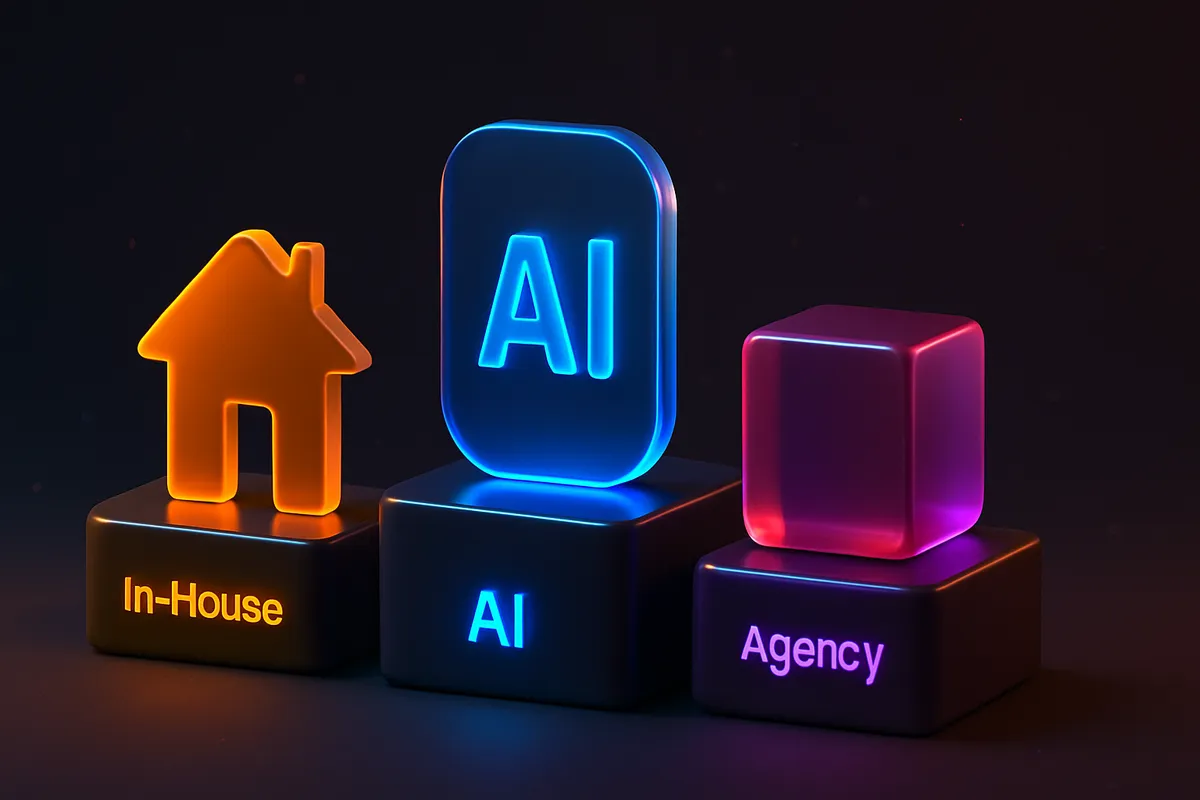
When short-form content becomes a real channel, you have to decide who makes it. Three models dominate: build it in-house, hire an agency, or lean on AI. Each solves a different constraint. The smartest small teams rarely pick just one.
The three models at a glance

| In-house | Agency | AI | |
|---|---|---|---|
| Cost | Salaries, ongoing | Retainer or per-project | Per render, predictable |
| Speed | Medium | Slower (rounds, approvals) | Fast |
| Capacity | Limited by headcount | Scales with budget | Scales easily |
| Expertise | Builds over time | High, immediate | Good, improving |
| Control | Full | Shared | Full |
| Brand fit | Deep, native | Needs onboarding | Strong with setup |
In-house: control and brand depth
An in-house creator or small team knows your product, your customers, and your voice better than anyone outside ever will. You get full creative control and fast internal feedback. The catch is capacity — one or two people can only ship so much, and salaries are a fixed cost whether or not output is high. In-house is excellent for quality and consistency, and a real bottleneck for volume.
Agency: expertise on demand
An agency brings senior skill and outside perspective you can't easily hire for. For a big launch, a brand refresh, or a campaign that needs polish, that expertise earns its keep. The tradeoffs are speed and cost: rounds of review, approvals, and retainers slow things down and add up. Agencies are great for high-stakes, lower-frequency work — and a poor fit for daily, high-volume posting.
AI: speed and volume
AI fills the gap the other two leave: predictable cost and easy scale. With Krex AI, you generate talking-head avatars, UGC-style ads, text-to-video scenes, and AI B-roll in one pipeline, each render 1 credit = 1 video, and you can push them live with built-in Automation and scheduling. That makes the daily feed — hook tests, platform variants, seasonal angles — finally affordable to produce at the pace short-form rewards.
The honest limit: AI is strongest on volume and iteration, and still benefits from a human setting strategy and judging the output. It's a multiplier on a good plan, not a substitute for one.
The hybrid that usually wins
Most growing brands shouldn't choose one. A practical split:
- In-house owns strategy, brand voice, and the highest-touch assets.
- An agency comes in for flagship launches and campaigns that need senior craft.
- AI carries the daily volume — the testing, the variants, the long tail that headcount and retainers can't cover.
Set your brand kit, avatars, and voices once, and AI stays on-brand while your people focus on the work only people can do.
Which should you pick?
If you need deep brand control, invest in-house. If you need senior expertise for big moments, bring in an agency. If you need speed, scale, and predictable cost for everyday output, add AI. The real answer for most teams is a stack: humans for strategy and hero assets, AI for the volume in between.
Want to see where AI fits in your stack? Check the pricing tiers — Free, Pro, and Studio scale with how much you ship — or start at the overview.